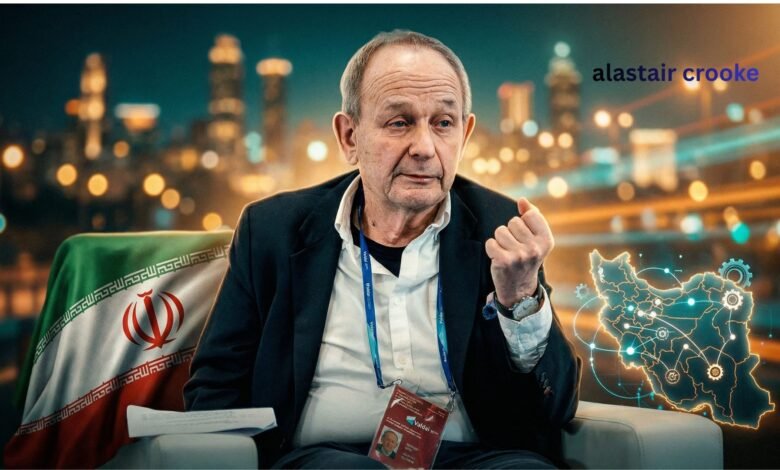
In a world where Middle East news often feels fragmented, emotional, and hard to interpret, many readers turn to voices who can connect the dots. One such figure is Alastair Crooke, a former intelligence officer and long-time observer of regional politics whose commentary continues to spark debate.


If you’ve ever struggled to understand why conflicts in the Middle East persist despite diplomacy, sanctions, and peace talks, you’re not alone. Most mainstream reporting explains events day by day, but rarely helps you understand the deeper logic behind them. This is exactly where Crooke’s analysis becomes relevant. He approaches the region not just as a journalist or commentator, but as someone shaped by decades of diplomatic and intelligence experience.
This article breaks down who Alastair Crooke is, how his thinking works, and why his perspective matters for understanding modern Middle Eastern geopolitics. You’ll also learn how to interpret his arguments critically, where his insights are most useful, and what common misunderstandings readers often have when engaging with his work. The goal is simple: to give you a clear, practical framework for understanding his analysis—without confusion, bias, or oversimplification.
Who Is Alastair Crooke?
Alastair Crooke is widely known as a former British diplomat and intelligence-linked mediator who later became the founder of the conflict resolution organization Conflicts Forum. His career spans diplomatic service in the Middle East and advisory roles connected to complex negotiations involving political and non-state actors.
What makes Crooke stand out is not just his background, but the way he interprets political behavior. Instead of treating Middle Eastern conflicts as isolated crises, he tends to view them as long-term structural tensions shaped by history, identity, and regional security dilemmas.
Key phases of his career perspective
- Diplomatic exposure to Middle Eastern political systems
- Experience observing non-state political movements up close
- Transition into independent geopolitical analysis
- Focus on conflict mediation and dialogue frameworks
This combination gives his commentary a distinctive tone: analytical, structural, and often critical of simplified Western narratives.
Understanding His Core Analytical Framework
To understand Crooke’s writing, you need to recognize that he rarely focuses only on “what happened.” Instead, he focuses on “why actors behave the way they do.”
1. Security dilemma thinking
One of his central ideas is that many conflicts are driven by mutual fear rather than pure aggression. In this view, every move by one actor creates defensive reactions in another, forming a cycle of escalation.
For example:
- Military expansion is interpreted as threat by neighbors
- Political alliances trigger counter-alliances
- Sanctions often reinforce resistance rather than compliance
This lens helps explain why many conflicts persist even when all sides claim to want peace.
2. Political identity as a driver of strategy
Crooke often emphasizes that political identity—religious, ideological, or historical—cannot be separated from strategy in the Middle East. In his analysis, identity is not symbolic; it is operational.
That means:
- Movements act based on legitimacy narratives
- States respond to identity-based threats, not just military ones
- Negotiations fail when identity concerns are ignored
This approach is particularly useful when analyzing groups that are often labeled only in security terms.
3. Long-cycle conflict perspective
Instead of viewing crises as short-term events, he tends to interpret them as part of long historical cycles. This shifts attention away from headlines and toward deeper structural forces.
What Makes His Perspective Different?
Many geopolitical analysts focus on policy, economics, or military strategy. Crooke’s approach is different in three important ways.
1. He prioritizes internal logic over external labeling
Rather than describing actors based on how they are labeled internationally, he tries to understand how they see themselves. This often leads to interpretations that differ from mainstream reporting.
2. He challenges linear narratives
Mainstream analysis often assumes:
- Pressure leads to compliance
- Sanctions weaken opposition
- Military dominance creates stability
Crooke frequently argues the opposite: pressure can strengthen resistance, and dominance can deepen instability.
3. He connects psychology with geopolitics
He often treats political behavior as emotionally and psychologically driven at a collective level—fear, dignity, humiliation, and legitimacy play major roles.
Practical Insights From His Work
Understanding Crooke is not just academic. His framework can help readers interpret global news more effectively.
Insight 1: Look for feedback loops, not isolated events
Instead of asking “What happened?” ask:
- What reaction did this trigger?
- How will the other side respond?
- Will this reinforce or weaken existing tensions?
Insight 2: Ignore surface statements, focus on incentives
Political statements often differ from actual incentives. Crooke’s approach encourages readers to examine:
- What each actor gains by continuing the conflict
- What risks they face if they change course
- Which internal groups influence decision-making
Insight 3: Stability is not always the default goal
A less obvious idea in his work is that some actors may prioritize survival, identity, or influence over stability. This challenges the assumption that all sides naturally seek compromise.
Common Misinterpretations of His Analysis
Because his writing is dense and unconventional, readers often misunderstand him.
Mistake 1: Confusing analysis with endorsement
Explaining why an actor behaves a certain way does not mean supporting that behavior. Crooke’s framework is descriptive, not promotional.
Mistake 2: Overgeneralizing his conclusions
Some readers apply his Middle East analysis globally without adjusting context. His framework is highly region-specific and shaped by historical conditions.
Mistake 3: Ignoring the limits of structural explanations
While structural factors matter, they do not explain everything. Leadership decisions, chance events, and external shocks also shape outcomes.
Real-World Application: How to Use His Lens
You don’t need to be a political scientist to use Crooke’s approach. You can apply it when reading news or analyzing global events.
Step-by-step method
- Identify all actors involved
- List their core fears and goals
- Map how each action affects others
- Look for escalation loops
- Separate messaging from incentives
This method helps transform confusing headlines into structured understanding.
2–3 Unique Insights Not Commonly Highlighted
1. Intelligence background influences pattern recognition
One under-discussed aspect of Crooke’s perspective is how intelligence work shapes analytical habits. Analysts with such backgrounds often prioritize:
- Behavioral consistency over rhetoric
- Long-term patterns over short-term noise
- Hidden motivations over public messaging
This leads to interpretations that may feel “contrarian” but are often rooted in pattern-based reasoning.
2. He treats diplomacy as a “translation problem”
Instead of seeing diplomacy as negotiation alone, his framework often resembles translation between incompatible political languages. Each side interprets concepts like “security” or “sovereignty” differently, which creates persistent misunderstanding.
3. Conflict persistence is often structural, not accidental
A key insight in his thinking is that some conflicts are sustained not because of failure, but because the system itself continuously reproduces tension. Even peace efforts can unintentionally reinforce underlying structures.
Why His Work Still Matters Today
In a rapidly changing geopolitical landscape, Crooke’s analysis remains relevant because it focuses on long-term forces rather than breaking news cycles.
Readers benefit from his approach when they want:
- A deeper understanding beyond headlines
- Context for recurring conflicts
- A structured way to interpret international events
However, it is equally important to balance his perspective with other viewpoints to avoid one-dimensional interpretation.
Conclusion
Understanding Alastair Crooke requires more than reading individual articles—it requires engaging with a way of thinking. His focus on structure, identity, and long-term dynamics offers a framework for interpreting conflicts that often seem chaotic on the surface.
At its core, his approach encourages readers to look beyond events and examine the systems that produce them. Whether you agree with all his conclusions or not, his analytical style provides a valuable tool for making sense of complex global issues.
The real takeaway is not to accept or reject his views wholesale, but to use them as a lens—one that helps you ask better questions about how and why conflicts unfold the way they do.
FAQ
1. Who is Alastair Crooke and why is he known?
Alastair Crooke is a former British diplomat and conflict analyst known for his commentary on Middle Eastern geopolitics. He is recognized for offering structural explanations of regional conflicts rather than event-based reporting.
2. What is unique about his analysis of the Middle East?
His analysis focuses on long-term security dynamics, identity politics, and feedback loops between regional actors. This makes his perspective different from mainstream political reporting.
3. Why do some people find his views controversial?
Some readers disagree with his interpretations because he challenges dominant Western narratives and emphasizes internal logic of regional actors. This can appear unconventional compared to mainstream analysis.
4. How can I use his ideas to understand world events?
You can apply his framework by analyzing incentives, mapping reactions between actors, and identifying long-term structural patterns rather than focusing only on daily news updates.
5. Is his analysis purely political or also psychological?
His approach blends political and psychological dimensions, often highlighting fear, legitimacy, and identity as key drivers of collective political behavior.