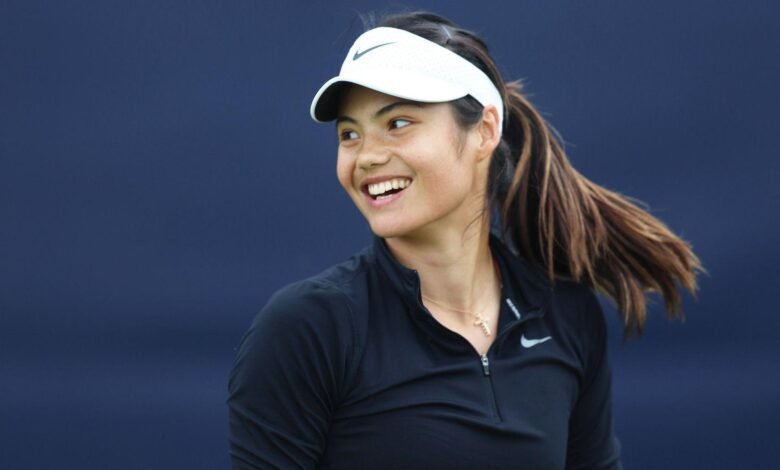
Few sporting careers have unfolded under such intense global attention so early. From a breakthrough that reshaped expectations to the quieter, more demanding work of long-term development, Emma Raducanu has become a defining figure of a new era in professional tennis. Her journey is not only about trophies and rankings, but about identity, resilience, and learning how to grow in public while staying grounded in private.


This article explores that journey in depth, focusing on background, mindset, challenges, and the evolving meaning of success in elite sport.
Emma Raducanu and the Roots of a Multicultural Identity
Understanding the early life of Emma Raducanu requires looking beyond tennis courts and scorelines. Born into a family with Romanian and Chinese heritage and raised in the United Kingdom, she grew up navigating multiple cultures, languages, and expectations. This multicultural environment shaped both her worldview and her discipline.
Her parents placed strong emphasis on education, balance, and self-reliance. Tennis was encouraged, but never allowed to dominate her identity completely. School, structure, and personal responsibility were treated as equally important. This approach created a foundation that later proved vital when fame arrived suddenly and without warning.
From an early age, she showed focus rather than flamboyance. Coaches often noted her ability to absorb instruction quickly and apply it with precision. Instead of relying purely on instinct, she built her game through understanding patterns, percentages, and mental clarity.
Early Development and Competitive Foundations
Junior tennis is often romanticized, but it is usually defined by repetition, sacrifice, and long periods without recognition. For Emma Raducanu, those years were marked by steady progress rather than dominance. She competed selectively, prioritizing learning over constant tournament exposure.
This measured path reduced burnout and allowed her body to develop naturally. She trained with intensity, but also with restraint. Fitness, flexibility, and injury prevention were treated as long-term investments, not short-term gains.
Her competitive instincts sharpened through adversity. Losses were analyzed carefully, not emotionally. Each match became a data point, a lesson, or a confidence builder. This analytical mindset would later distinguish her during high-pressure moments on the biggest stages.
Breakthrough and the Shock of Global Attention
The moment that transformed Emma Raducanu from promising talent to global headline arrived with breathtaking speed. What followed was not just celebration, but a complete shift in daily life. Media attention multiplied. Expectations escalated. Every decision became a public talking point.
Sudden success can be destabilizing, especially for someone still forming their professional identity. She faced demands that experienced athletes often struggle with: sponsorships, interviews, travel schedules, and constant scrutiny. Managing these pressures required rapid adaptation.
Importantly, she did not attempt to become someone else overnight. Her responses remained measured. She spoke openly about learning, adjusting, and understanding that growth is not linear. That honesty resonated with fans who recognized the human reality behind the results.
Technical Style and On-Court Intelligence
From a technical perspective, Emma Raducanu is often described as a clean striker of the ball. Her game is built on timing, balance, and controlled aggression rather than raw power. She takes the ball early, changes direction efficiently, and uses depth to create openings.
Her movement reflects discipline rather than flash. Footwork is economical. Shot selection is thoughtful. Instead of forcing winners, she constructs points patiently, waiting for the right moment to apply pressure.
Mentally, she shows an ability to reset quickly. Mistakes do not linger. This trait, often undervalued, is essential at elite level where margins are slim and momentum can shift in seconds. Her calm presence between points suggests a player who understands emotional regulation as part of performance.
Setbacks, Injuries, and the Reality of Progress
Every promising career encounters resistance. For Emma Raducanu, injuries and form fluctuations became part of the narrative soon after her rise. Rather than signaling failure, these challenges revealed the physical and psychological demands of sustaining excellence.
Rehabilitation tested patience. Time away from competition required trust in process rather than results. She spoke candidly about learning her body, listening to warning signs, and accepting that rest is not weakness.
Setbacks also forced reassessment of training methods, scheduling, and support systems. These adjustments are rarely visible to audiences, yet they shape careers more than single matches. The willingness to adapt, rather than deny difficulty, became a quiet strength.
Media, Expectations, and Personal Boundaries
Modern athletes exist in an environment where visibility is constant. For Emma Raducanu, maintaining personal boundaries has been an ongoing task. Social media, commentary, and speculation can amplify both praise and criticism to unrealistic levels.
She has chosen a selective approach to public engagement. Rather than oversharing, she communicates with intention. This restraint protects mental space and allows focus to remain on development rather than validation.
Crucially, she does not frame pressure as something to eliminate, but something to understand. By acknowledging expectations without letting them define her self-worth, she demonstrates emotional maturity beyond her years.
Growth Beyond Rankings and Results
One of the most compelling aspects of Emma Raducanu is how she defines progress. While rankings matter, they are not treated as the sole measure of success. Improvement is evaluated through consistency, health, decision-making, and confidence.
She has emphasized learning how to compete when conditions are not ideal. Travel fatigue, unfamiliar environments, and tactical mismatches are approached as part of the profession, not excuses. This mindset supports long-term sustainability.
Off court, interests beyond tennis remain present. Education, culture, and curiosity continue to play a role in her identity. These elements create balance, reducing the risk of being consumed entirely by results.
The Broader Meaning of Her Journey
Beyond individual achievements, Emma Raducanu represents a shift in how young athletes are perceived. Her story challenges the idea that success must follow a rigid timeline or a single path. It highlights the importance of adaptability, patience, and self-awareness.
She has become a reference point for conversations about youth development, media responsibility, and athlete well-being. Not through activism or slogans, but through lived experience and thoughtful responses.
Her career is still unfolding. What makes it compelling is not certainty, but openness. Each chapter builds on the last, shaped by reflection rather than reaction.
Conclusion
At this stage, the story of Emma Raducanu is not about final judgments or fixed labels. It is about evolution. From a disciplined junior to a global champion, and from sudden fame to deliberate rebuilding, her journey illustrates how modern sport demands more than talent alone.
What stands out is her commitment to learning, even when learning is uncomfortable. She accepts complexity rather than chasing simplicity. In doing so, she offers a model of success grounded in growth, balance, and resilience.
As her career continues, one truth remains clear: lasting impact is rarely defined by a single moment, but by the ability to navigate everything that follows with clarity and purpose.